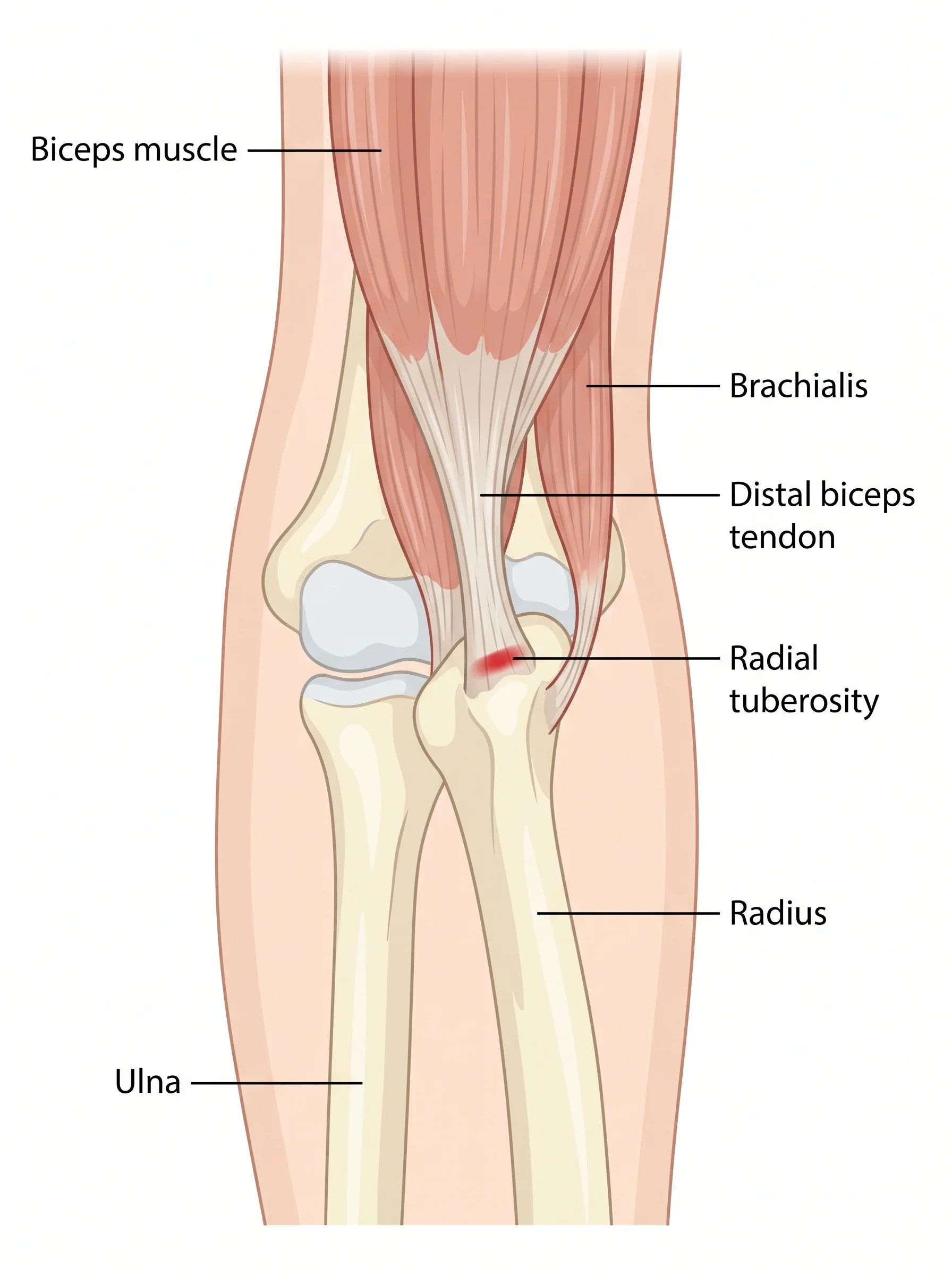
Distal biceps repair is surgery that reattaches a biceps tendon that has torn from the forearm bone at the elbow. Dr. Levongood performs distal biceps repair in Lawrenceville, most often soon after a complete tear, to restore the arm's bending and rotating strength.
Gary Levongood performs distal biceps repair in Lawrenceville when it is the right step, and reviews every alternative with you first.
What is Distal Biceps Repair?
The biceps muscle attaches near the elbow by the distal biceps tendon, which anchors to a forearm bone called the radius.
This attachment helps you bend the elbow and turn the forearm palm-up, such as when using a screwdriver.
A distal biceps tear usually happens suddenly, often when a heavy load is placed on a bent elbow, like catching a falling object. People often feel a pop, then notice bruising, swelling, and a change in the shape of the upper arm along with weakness turning the forearm.
Unlike some tendon problems, a complete distal biceps tear does not reattach on its own. Surgery is commonly recommended, especially for active people, and is more successful when done relatively soon after the injury.
What happens during Distal Biceps Repair, step by step?
The surgeon makes an incision at the front of the elbow, locates the retracted tendon, and reattaches it to the radius bone.
The tendon is secured with small anchors, a button device, or sutures through the bone, depending on the technique. One or two small incisions may be used. The goal is a firm reattachment that lets the tendon heal back to bone. Your physician will explain the approach and the protective plan afterward.
What is recovery like after Distal Biceps Repair?
Recovery is staged to protect the healing tendon.
The elbow is often protected in a splint or brace at first, with motion advanced gradually and strengthening added later. Many people regain functional use over several months, with return to heavier lifting and demanding activity commonly around four to six months, according to general guidance from the American Academy of Orthopaedic Surgeons. These are ranges, not promises. Following the protected timeline matters, since loading the tendon too soon risks the repair. Your physician and therapist will guide each stage.
Read the full guide to preparing for surgery →
Your own recovery instructions come from the office and are specific to you. This page describes the general course, not a plan to follow.
What do patients ask most?
Does a distal biceps tear heal on its own?+
Is there a time limit for surgery?+
How much strength will I get back?+
How long until I can lift heavy again?+
What are the treatment options?
- 01Rest, ice, and activity changes to settle the initial injuryRest, ice, and activity changes to settle the initial injury.
- 02Therapy to maintain motion, chosen for lower-demand patients or partial tearsTherapy to maintain motion, chosen for lower-demand patients or partial tears.
- 03This path accepts some lasting loss of forearm rotation and bending strengthThis path accepts some lasting loss of forearm rotation and bending strength.
- 04Distal biceps repair is recommended for most active people with a complete tear, and is moDistal biceps repair is recommended for most active people with a complete tear, and is more successful when done relatively soon after the injury before the tendon retracts and scars.
Fellowship trained at The Hughston Clinic (Sports Medicine). Sees patients in Lawrenceville.
About Dr. Levongood →