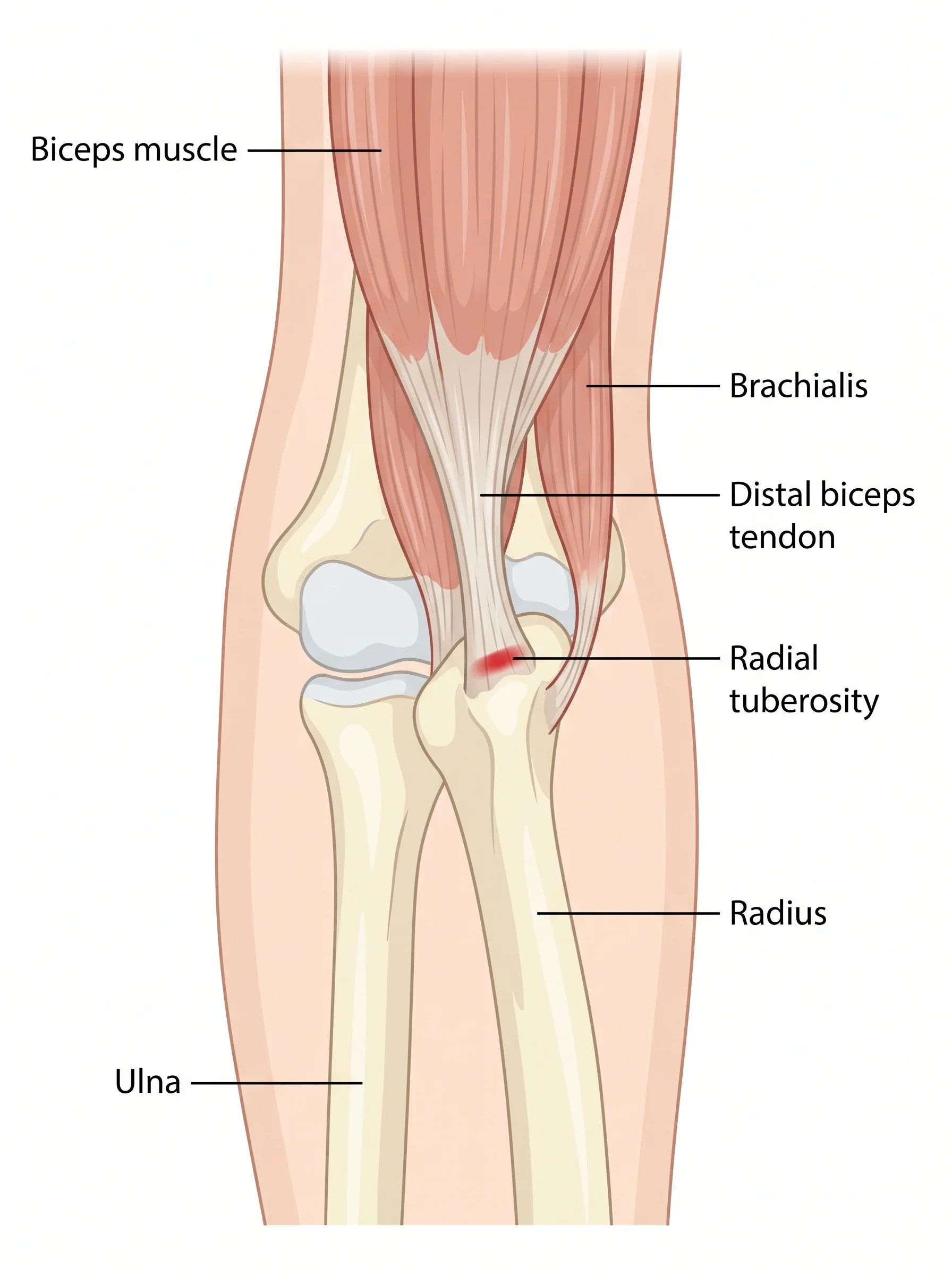
The distal biceps tendon connects the biceps muscle to the forearm bone near the elbow. When it tears off, the arm loses strength for lifting and turning the palm up. Distal biceps repair is surgery that reattaches the tendon to the bone. These are ranges, not promises.
Gary Levongood performs distal biceps repair in Lawrenceville when it is the right step, and reviews every alternative with you first.
What is Distal Biceps Repair?
The biceps is the muscle on the front of your upper arm.
At the elbow, it connects to the radius, one of the two forearm bones, through the distal biceps tendon. A tendon is the tough cord that joins muscle to bone. This tendon does two main jobs: it helps you bend the elbow, and it is the main muscle that turns your palm face up, a motion called supination, such as when you turn a doorknob or use a screwdriver.
A distal biceps tear happens when this tendon pulls off the bone, usually all at once. It most often occurs when the arm is forced to straighten against a heavy load, for example when catching a falling object or lifting something heavier than expected. Many people feel a sudden pop and a sharp pain at the front of the elbow, followed by bruising and a change in the shape of the upper arm as the muscle bunches up.
Unlike some tendon problems, a fully torn distal biceps tendon does not reattach on its own. Surgery is often recommended, especially for active adults, because reattaching the tendon restores the strength for turning the palm up, which is hard to regain otherwise. Some people, particularly those with lower demands or certain health concerns, choose nonsurgical care and accept some loss of strength. The decision is shared.
This page covers the symptoms, diagnosis, treatment choices, the surgery, and recovery. It pairs with our shorter distal biceps repair service page. You can read either first.
What are the symptoms of Distal Biceps Repair, and when should you see a specialist?
The most telling symptom is a sudden pop or tearing feeling at the front of the elbow during a hard lift or strain, followed by pain.
Because the tear often happens in one moment, many people can name the exact activity.
Common symptoms include:
- Sharp pain at the front of the elbow at the time of injury, easing to an ache over days. - Bruising and swelling at the elbow and forearm. - A change in the shape of the upper arm, where the muscle bunches up toward the shoulder, sometimes called a "Popeye" look. - Weakness when bending the elbow and, especially, when turning the palm up. - A gap or dent you can feel at the front of the elbow where the tendon used to attach.
Because a full distal biceps tear does not heal on its own and repair works best when done soon, see a specialist quickly, ideally within a couple of weeks of the injury. Waiting can make the repair harder because the tendon pulls back and tightens. If you felt a pop at the elbow during a heavy lift and now have weakness or a changed arm shape, get evaluated promptly. A hand and upper-limb specialist can confirm the tear and advise on timing.
How is Distal Biceps Repair diagnosed, and what does the visit involve?
Diagnosis often starts with the story of a sudden pop during a heavy strain, which is a strong clue.
The specialist will ask exactly how the injury happened and how the arm has felt since.
On exam, the specialist looks at the shape of the arm and feels the front of the elbow for the tendon. A common test, the hook test, checks whether the doctor can hook a finger under the tendon at the elbow; if the tendon is torn, there is nothing to hook. The specialist also tests strength when you turn your palm up and bend your elbow, comparing the two arms.
Imaging confirms the diagnosis and shows whether the tear is complete or partial. An MRI, a scan that shows soft tissue, can show the tendon and how far it has pulled back. Ultrasound is another way to look at the tendon. X-rays may be taken to check the bone, though they do not show the tendon itself.
Bring the details of the injury, including the date, since timing affects the plan. If you have imaging from an urgent care or emergency visit, bring it or have it sent ahead.
Felt a pop at the front of your elbow? Timing matters, so do not wait. Call (404) 847-4180 or use the request form to see Dr. Levongood.
What happens during Distal Biceps Repair, step by step?
Distal biceps repair reattaches the torn tendon to the radius bone.
Surgeons use different techniques and fixation methods, but the general sequence is similar.
Anesthesia. You will get either a regional block that numbs the arm, or general anesthesia. The team will help you choose.
The incision. The surgeon makes an incision at the front of the elbow. Some surgeons use one incision; others use two smaller ones, one in front and one on the back of the forearm. The choice depends on the surgeon's judgment and the tear.
Finding and preparing the tendon. The surgeon locates the torn end of the tendon, which has usually pulled back up the arm, and gently brings it down to where it belongs. Damaged or frayed tissue is trimmed.
Preparing the bone. The surgeon prepares the spot on the radius where the tendon attaches, making a small area or tunnel to hold the tendon.
Reattaching the tendon. The tendon is fixed to the bone using one of several methods, such as small anchors, a button device, or screws that hold the tendon in the bone. The method varies by surgeon and case; all aim to hold the tendon firmly while it heals.
Closing. The incision or incisions are closed with stitches, and the arm is placed in a splint or brace to protect the repair. Your surgeon will explain which technique and fixation were used, since these shape your recovery plan.
Distal biceps repair is usually outpatient, meaning you go home the same day.
What is the recovery timeline for Distal Biceps Repair?
Recovery is deliberate, because the tendon needs time to bond to the bone before it is loaded.
Progress is best judged by what the arm can safely do. According to general guidance from the American Academy of Orthopaedic Surgeons, return to full activity after distal biceps repair often takes several months, with heavy lifting typically held until the repair is well healed. These are ranges, not promises.
Milestones by what you can do:
- Protected phase (first few weeks). A splint or brace guards the repair, sometimes limiting how far you straighten the elbow at first. You keep the fingers, wrist, and shoulder moving. The milestone is a protected, healing repair with the rest of the arm staying mobile. - Motion phase (roughly weeks 2 to 8). With the surgeon's guidance, a brace allows a widening range of elbow motion, and a therapist helps you regain full bending and straightening. Lifting stays limited. The milestone is smooth elbow and forearm motion without stressing the repair. - Strengthening phase (often months 2 to 4). Once the tendon is healing well, therapy gradually adds strengthening, including turning the palm up. The milestone is steadily returning strength within the surgeon's limits. - Return to full activity (often months 4 to 6 or longer). Heavy lifting and forceful, repeated arm work return last, only after the repair is well healed. The milestone is doing your usual heavy tasks without pain or a sense of weakness.
The lifting limits early on are important; loading the repair too soon can pull it loose. Light desk work often resumes within a week or two if the other arm can carry the load. Your surgeon sets the pace based on the technique used and how you are healing.
Read the full guide to preparing for surgery →
Your own recovery instructions come from the office and are specific to you. This page describes the general course, not a plan to follow.
How should you prepare for Distal Biceps Repair?
Good preparation matters here because your arm will be protected and your lifting limited for weeks.
Home setup. Move daily items to easy-to-reach spots so you avoid lifting with the repaired arm. Prepare simple meals in advance. Loose clothing works better over a brace than tight sleeves.
Transportation. You cannot drive yourself home after anesthesia, so arrange a ride for surgery day. You will not be able to drive while your arm is braced and your lifting is limited, which can be several weeks, so plan rides and ask your surgeon when driving is safe.
Time off. Desk work may resume within a week or two; jobs that need lifting or forceful arm use are held much longer, often a few months. Ask the office for a work note if you need one.
Who to have available. Have someone help for the first several days with meals, dressing, and errands, since one arm will be limited. If the repaired arm is your dominant one, plan for more help.
Health steps. Share your full medicine and supplement list, since some, such as blood thinners, may need adjusting. If you smoke, know that not smoking supports tendon and wound healing. Follow the fasting instructions for the night before surgery.
Which warning signs should you call about?
Call the office of Gary Levongood at (404) 847-4180 if you notice any of these after surgery.
- Fever, chills, or spreading redness around the incision, which can signal infection. - Drainage that turns thick, cloudy, or foul-smelling, or an incision that opens. - Pain that keeps getting worse rather than easing, or pain your prescribed plan does not control. - New or worsening numbness, tingling, or weakness in the hand or forearm, which can signal nerve irritation. - A sudden pop or a feeling that the repair gave way, especially after lifting against your surgeon's limits. - A brace or dressing that feels far too tight, or fingers that turn pale or blue. - Calf pain, chest pain, or trouble breathing, which need emergency care right away.
For an emergency, call your local emergency number rather than the office. For wound and pain questions during office hours, the office team is your first call, and they can tell you who to reach after hours.
What results can you expect from Distal Biceps Repair?
Most people who have a distal biceps repair regain strong, reliable use of the arm, including the strength to turn the palm up.
According to general guidance from the American Academy of Orthopaedic Surgeons, surgical repair restores much of the arm's strength for most patients, especially when done soon after the injury. These are ranges, not promises.
A few honest points:
- Repair done early, before the tendon tightens and scars back, tends to be more straightforward and more complete. - Strength for turning the palm up is the ability most improved by repair, compared with nonsurgical care. - Full strength and endurance can take several months to return, and some people notice minor differences between arms.
Risks include infection, nerve irritation that can cause temporary numbness or weakness in the forearm or hand, stiffness, and, uncommonly, the repair pulling loose or extra bone forming near the elbow. Your surgeon will review the risks that apply to your case and the timing of your injury before you decide. Any numbers you read online come from mixed groups and may not match your situation, so rely on the conversation with your surgeon.
What do patients ask most?
Do I have to have surgery for a distal biceps tear?+
Why does timing matter so much?+
How much strength will I get back?+
When can I lift heavy things again?+
Will I have one incision or two?+
What about cost and insurance?+
What are the treatment options?
- 01Nonsurgical caremay be chosen by people with lower physical demands, by those for whom surgery carries added health risks, or by those who prefer to avoid an operation. It involves:
- 02A short period of rest and, sometimes, a sling for comfortA short period of rest and, sometimes, a sling for comfort.
- 03Pain control with medicine, discussed with the officePain control with medicine, discussed with the office.
- 04Hand or physical therapy to regain motion and build what strength is possibleHand or physical therapy to regain motion and build what strength is possible.
- 05Surgical repairis often recommended for active adults and for anyone who needs full strength for work or sports, because it restores the tendon's attachment and, with it, most of the strength. Because the repair is easier and more complete when done soon after the injury, the timing of the decision matters.
Fellowship trained at The Hughston Clinic (Sports Medicine). Sees patients in Lawrenceville.
About Dr. Levongood →